
A new publication from Tais C. de Menezes, Amanda M. Countryman, Dustin L. Pendell, Jonathan Rushton, Jimmy Tickel and Heather Simmons has recently been published. Titled ‘Potential economy-wide impacts of an African swine fever outbreak in the United States‘, and available online here.
Summary
Introduction: African swine fever (ASF) poses a major threat to the U.S. pork sector, with potentially large spillovers through domestic markets and international trade. To inform preparedness and policy design, we quantify the economy-wide consequences of a hypothetical ASF outbreak under alternative scenarios of production losses and export restrictions.
Methods: We use a computable general equilibrium (CGE) model to simulate four hypothetical ASF scenarios that vary by outbreak size and export restrictions. The model endogenously captures adjustments in production, prices, bilateral trade flows, and welfare, and we assess robustness using systematic sensitivity analysis.
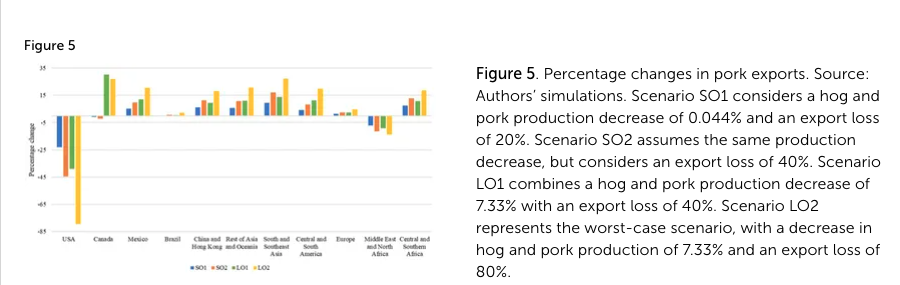
Results: Small outbreak scenarios generate limited sectoral disruption and no substantial GDP effects, with U.S. welfare losses of $310–$563 million. Large outbreak scenarios reduce U.S. hog production by 7.34%–8.57% and pork production by 7.25%–10.8%, increase U.S. hog producer prices by 41.6%–41.8% and pork prices by 6.5%, and reduce U.S. GDP by 0.05%. Corresponding U.S. welfare losses rise to $10.9–$11.4 billion. Globally, large outbreaks increase world hog and pork prices by 3.67%–3.69% and 1.20%–1.22%, respectively, and drive trade diversion toward alternative exporters.
Discussion: The results indicate that the economic costs of ASF increase substantially with outbreak size and are shaped by the severity of trade restrictions. Investments that prevent escalation (early detection, rapid containment) and strategies that preserve market access (credible regionalization/zoning arrangements) can substantially reduce welfare losses and global market disruption.
If you have any questions relating to the publication above, don’t hesitate to get in touch with us!